 Shot on 26 Apr 20214 photos
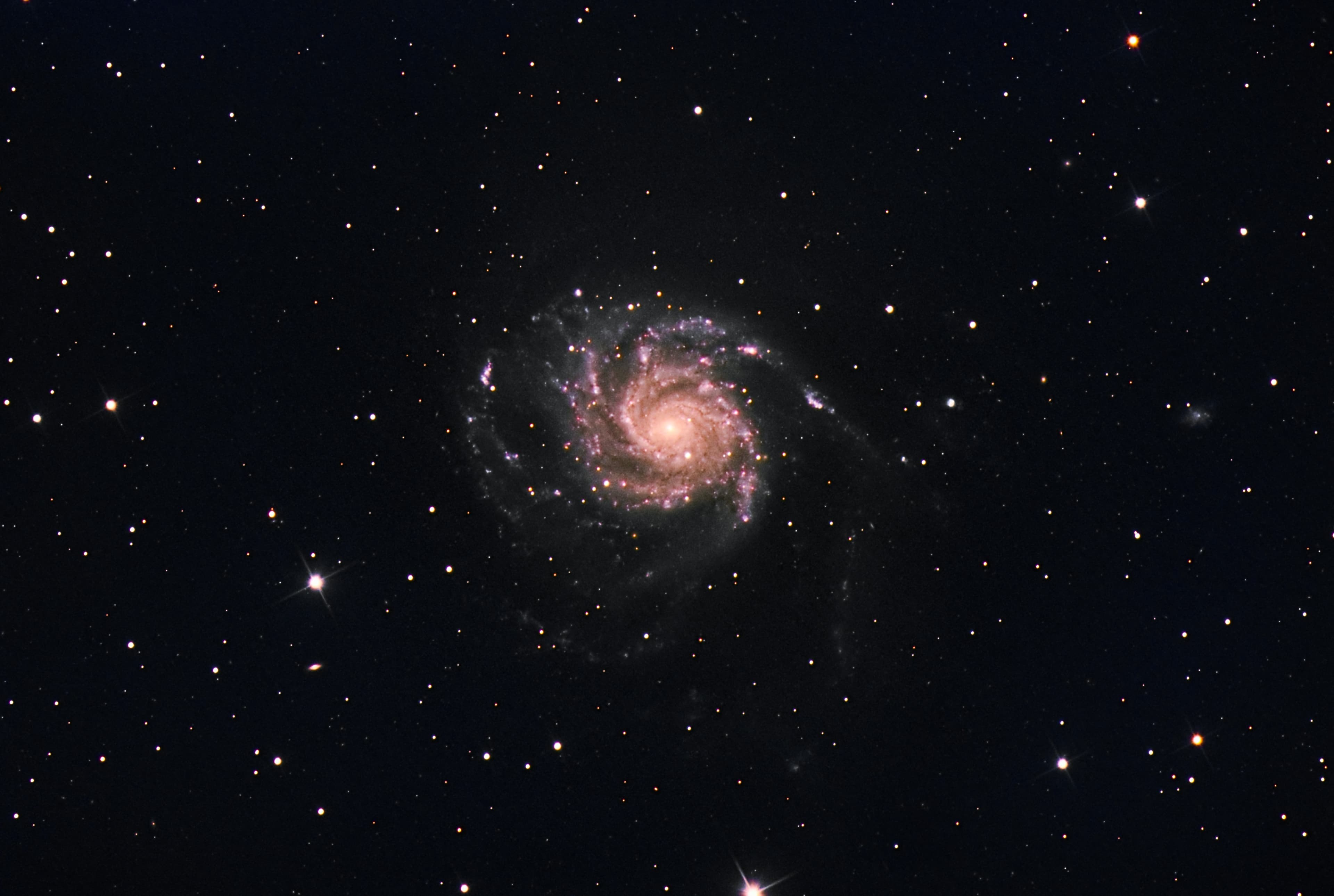
M 101
Pinwheel Galaxy
- Right ascension
- 14ʰ 04ᵐ 02ˢ
- Declination
- +54° 22′
- Constellation
- Ursa Major
- Type
- Galaxy
- Angular size
- 22 × 21′
- Magnitude
- 7.86ᵐ
- Tonight
- Never sets
- yes, circumpolar
- total exposure
- 15 h 35 min
- frames in the FITS archive
- 193
- imaging nights
- 8
- imaging period: 20 Aug — 27 Jul
- 2020–2023
Visibility and signal
Exposure by filter
- L3 h 25 min · 47 frames
- R4 h 10 min · 50 frames
- G3 h 15 min · 39 frames
- B3 h 15 min · 39 frames
- Hα1 h 30 min · 18 frames
Share of each filter in the total exposure
- Narrowband filters
- 10%needs a dark sky
- Typical frame
- 291 s193 frames in total
- In one night
- 1 h 57 minaveraged over 8 nights
Altitude above the horizon tonight
Observing log8 nights · 193 frames
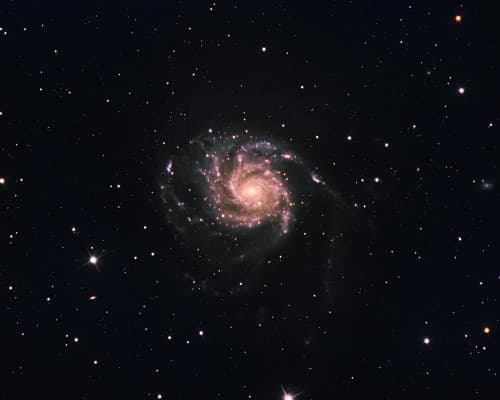
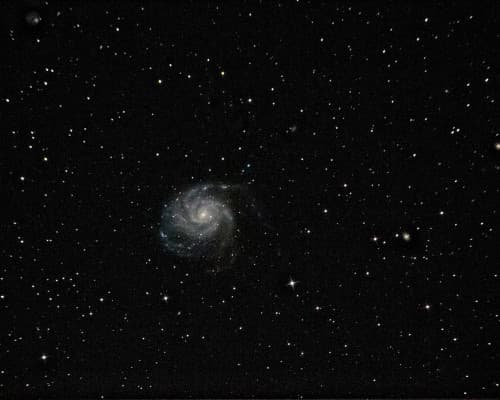
Photos of the objectEach photo is a separate processing; parameters and equipment are on the photo page

About the object
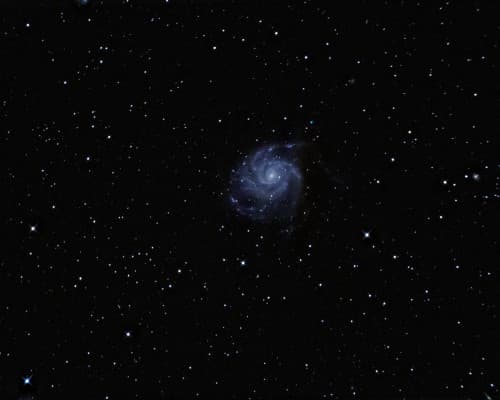
The Pinwheel Galaxy (M101), also known as the Pinocolat Galaxy, is a spiral galaxy located in the constellation Ursa Major. It attracts the attention of astronomers with its beautiful spiral structure and bright star clusters.
Description and discovery
The galaxy has a diameter of about 170,000 light-years, which is almost twice the diameter of our Milky Way. It is located at a distance of about 21 million light-years from Earth and belongs to the M101 group of galaxies. The galaxy was discovered by Pierre Méchain in 1781.
The Pinwheel Galaxy is known for its vigorous star-forming activity, especially in its spiral arms, where new stars are formed from clouds of gas and dust.
Structure and Composition
The galaxy has a high density of H II regions, which are areas of intense star formation within giant molecular clouds of hydrogen. In these regions, young stars and star clusters create bright superbubbles.
The galaxy is asymmetrical due to gravitational interactions with neighboring galaxies, which leads to intense star formation in its spiral arms.
Companion Galaxies
M101 has six large companion galaxies, including NGC 5204, NGC 5474, NGC 5477, NGC 5585, UGC 8837, and UGC 9405. These galaxies interact with M101, creating its "grand design" structure.
Supernovae and other phenomena
The Pinwheel Galaxy is known for its supernovae. In particular:
- SN 1909A (discovered in 1909)
- SN 1951H (discovered in 1951)
- SN 2011fe (discovered in 2011, type Ia)
- SN 2023ixf (discovered in 2023, type II)
These events help scientists study star formation processes and the evolution of galaxies.
Conclusion
The Pinwheel Galaxy is a striking example of a spiral galaxy with high star formation activity and interesting astronomical phenomena. Studying its structure and interactions with neighboring galaxies expands our knowledge of galaxy formation and the evolution of stellar systems.