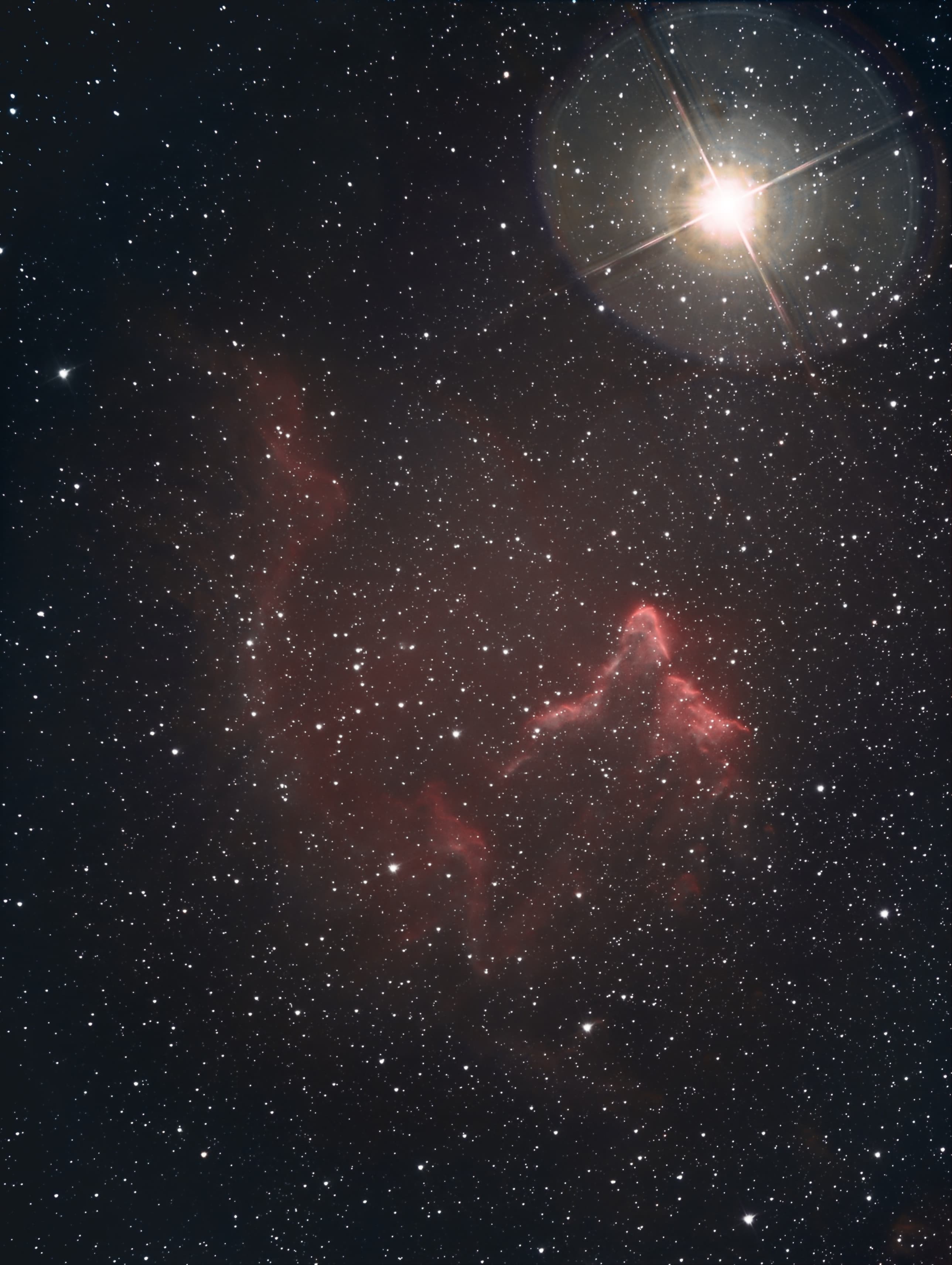
 Shot on 23 Jan 2021
IC 63
Ghost Nebula
- Right ascension
- 0ʰ 58ᵐ 42ˢ
- Declination
- +61° 04′
- Constellation
- Cassiopeia
- Tonight
- Never sets
- yes, circumpolar
- total exposure
- 11 h 10 min
- frames in the FITS archive
- 134
- imaging nights
- 2
- imaging period: 31 Aug — 1 Sept
- 2020
Visibility and signal
Exposure by filter
- Hα3 h 45 min · 45 frames
- OIII3 h 45 min · 45 frames
- SII3 h 40 min · 44 frames
Share of each filter in the total exposure
- Narrowband filters
- 100%can be shot under the Moon
- Typical frame
- 300 s134 frames in total
- In one night
- 5 h 35 minaveraged over 2 nights
Altitude above the horizon tonight
Observing log2 nights · 134 frames
Photos of the objectEach photo is a separate processing; parameters and equipment are on the photo page

About the object
The Ghost Nebula (IC 63), also known as NGC 1977 or the Horsehead Nebula, is a dark nebula located in the constellation Orion. This astronomical object gets its name from its shape, which resembles the silhouette of a horse's head.
Structure and observations
The Ghost Nebula is a region of gas and dust that obscures the light behind it, creating the effect of a dark cloud against the brighter stars. It is located near the open star cluster NGC 1981 and is associated with a cloud of gas and dust known as the Orion Cloud. The nebula has an interesting structure and contains molecular clouds from which new stars may be forming.
Astronomers use infrared and radio telescopes to study the Ghost Nebula. This allows us to study the characteristics of the dust and gas, the distribution of matter within the nebula, and its interactions with surrounding stars and gas.
Significance for Astronomy
The Ghost Nebula is of interest to astronomers because it allows us to study the processes of star formation and the evolution of molecular clouds. Studying it helps to expand our knowledge of the mechanisms of star formation and the evolution of galactic clouds of gas and dust.
Parallels with the Cassiopeia Nebula
The IC 63 nebula is also known as the Ghost of Cassiopeia and is located 550 light-years away in the constellation Cassiopeia. This nebula is illuminated by the super-luminous blue star Gamma Cassiopeiae, which emits as much energy as 34,000 suns. New stars are forming in the clouds of gas and dust near the nebula. The nebula itself appears red because the hydrogen in it is irradiated by ultraviolet light from Gamma Cassiopeiae.
The IC 63 nebula is part of a much larger nebula that surrounds the star Gamma Cassiopeiae and extends for about two degrees on the sky (or four times the diameter of the full Moon).
Observations and Visibility
The constellation Cassiopeia is visible every clear night from northern latitudes. Its distinctive "W" shape is part of the astronomical image of the Queen's throne. The star Gamma Cassiopeiae, located in the middle of the "W", is visible to the naked eye, but a large telescope is required to see the IC 63 nebula.